Address
Industrial Zone, Xinxiang City, Henan Province, China
Work Hours
Monday to Friday: 7AM - 7PM
Weekend: 10AM - 5PM

1. The Crucial Question: Why Lift Capacity Matters
When renting or buying a Cherry Picker (or Boom Lift), the most critical specification isn’t just how high it can go, but how much weight it can safely carry. This is known as the Lift Capacity (or Rated Load).
The lift capacity determines the total weight the platform can handle, which includes:
Exceeding the lift capacity is extremely dangerous. Modern lifts are equipped with overweight sensing systems that will trigger an alarm and automatically shut down lifting functions if the limit is breached, preventing catastrophic accidents.
The lift capacity varies significantly based on the machine’s type, size, and design. Here is a simplified breakdown of the general ranges:
| Cherry Picker Type | Typical Capacity Range (Approximate) | What the Capacity Allows |
| Telescopic Boom Lift (Diesel) | 200kg-480kg (440lbs-1,058lbs) | Up to three workers plus heavy tools and moderate materials (high capacity for stability at extreme heights). |
| Articulating Boom Lift (Electric/Diesel) | 200kg-480kg (440lbs-1,058lbs) | Two to three workers, often with a focus on maneuvering flexibility over maximum load. |
| Mast Boom Lift (Vertical / Forklift Style) | 200kg (440lbs) | One to two workers plus light tools (designed for compact size and precision in narrow spaces). |
It is important to know that a Cherry Picker’s capacity is often not fixed. On many larger Articulating and Telescopic Lifts, the load capacity can change depending on the boom’s extension.
These capacity limits are detailed in the machine’s Load Chart, which is a mandatory safety document posted at the ground controls and usually on the platform itself.
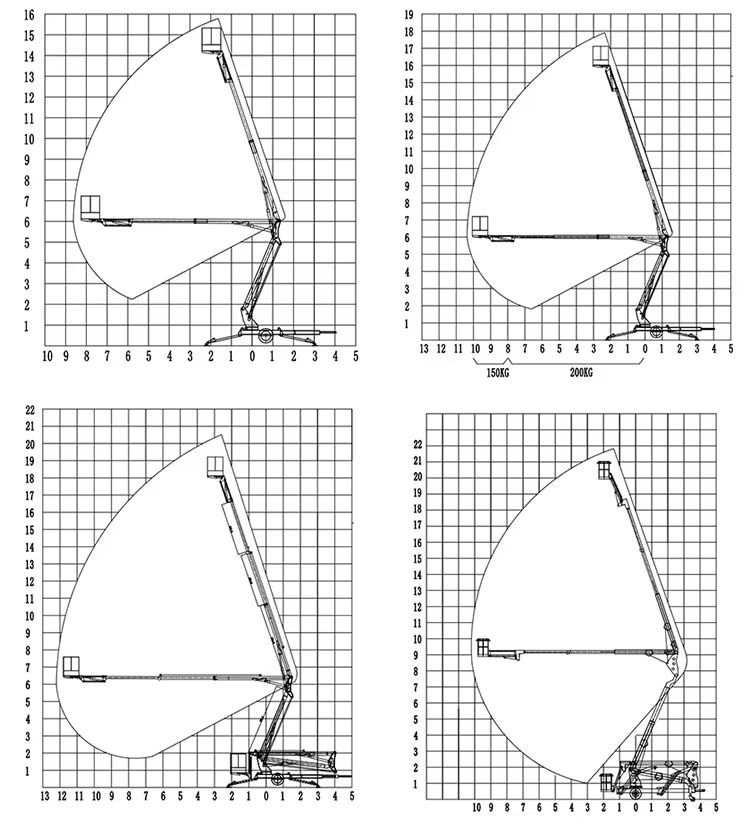
Some advanced boom lifts offer Dual Capacity modes:
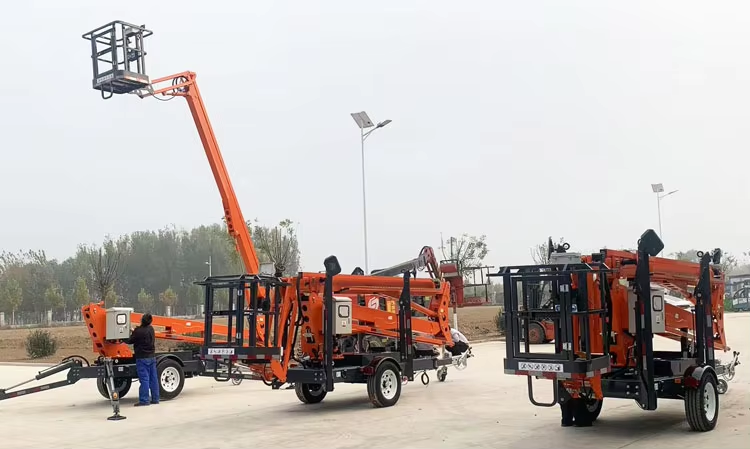
Modern lifts are smarter than ever before. They use sophisticated safety monitoring systems and often feature Load Sensing Systems integrated into the hydraulic circuit.
If an operator loads $201 \text{ kg}$ onto a platform rated for $200 \text{ kg}$, the machine will do one of two things:
This crucial technology ensures that operators cannot unintentionally compromise the machine’s stability and safety envelope.
While the question “How much weight can a Cherry Picker lift?” has general answers, the only answer that matters for your job is the number printed on your specific machine’s safety plate.
Always calculate the total weight of your crew, tools, and materials before stepping onto the platform. Knowing and respecting the load chart is the most fundamental rule for safe and efficient aerial work.